
Belonging
Rebecca Clancy
Genesis 25:19-26 Matthew 14:22-33
A close friend of mine has an unusual hobby. She photographs windows. Since there is no shortage of windows out there, her collection of photographs has grown to be enormous. She has, over the years, developed a real eye for them. She goes everywhere, camera in hand, vigilant for new material.
She gave me a gift a few years back. She took a trip to Disney World, and knowing that the kids and I are Disney fanatics, she created a photo album for us entitled, The Windows of Disney. Needless to say, it is one of my prize possessions.
At any rate, I visited her apartment recently. One whole wall was covered with photographs of windows from all over the world. I must say her hobby is very compelling to me. I had been riveted at the wall for nearly half an hour, when she made an unexpected disclosure. “I finally figured out why I photograph windows,” she said. “Why?” I asked. “Because for as long as I remember I feel like I have been looking at life through windows.” “What do you mean by that?” I asked, intrigued. “I guess I have always felt like I was on the margins looking in at the center.” “What!?” I asked again, my intrigue now turning to concern.” “You know, isolated, apart, an outsider…” “But why!?” I persisted, my concern now turning to chagrin. I began to feel welling up in me that well-meaning but misguided urge to fix everything. “I grew up on the wrong side of the tracks,” my friend continued. “My parents were divorced. I am divorced. I didn’t start college till I was 30. I never found a profession….You name it.”
I was shocked -- shocked that I had known her for forty years and never knew she felt that way, and shocked that she felt that way in the first place. But as it sank it, it struck me that all sorts of people may feel that way – people, like my friend, who is finding her way in life along a bumpy road; people who emigrated or migrated to a newly adopted homeland; people of racial minorities, people of alternative sexual orientations or identities; people who represent various servant classes, people who have been barred admission to an “in-crowd”; people chasing after beauty or youth; people who lacked the privilege to receive an education; people who are the black sheep of their families; people who are unemployed; people who in atypical families; people who are impoverished, people who life has left lonely…All sorts of people. It’s just not the kind of thing you normally admit: that you lack and grieve a sense of belonging.
The yearning to belong runs deep and strong, and therefore it has become embedded in our society. Our society is shot through with mores, institutions, inducements, and attitudes that respond to the yearning to belong. Our society has made something of a game out of the yearning to belong. And with all games, there are winners and losers. The winners, through luck, privilege, or ambition, position themselves so that they belong. The losers feel like they’re looking through windows at life.
At any rate, it’s not just our society that is this way. It’s probably all societies, but it’s certainly biblical society. Something like this must have been going on with Jacob. Fate had cast him to feel like he would be looking through windows at life. It was the fault of his birth order. In biblical society to be the first born son was everything. It meant that you inherited the wealth, the property, the family name, the family line, the family position…. But Jacob was not the first born son. He missed out literally by seconds, for he was a second born twin. The first born son was his brother Esau. In fact, they came out in one piece, because as they were delivered, Jacob was grasping onto Esau’s heal. It was that close. But Esau was the first born son, and as such, he would inherit all the stature due him. It was Jacob’s lot to sink into insignificance and obscurity.
And to compound the insult, Jacob, to his mind at least, was the superior brother. He deemed Esau to be, to put it bluntly, a lunkhead -- a ruddy, hairy brute of a man who wiled away his days in the field hunting game. Jacob deemed himself to be the more cerebral, the more subtle, the more complex, the cannier of the two. And so Jacob determined that he would trick fate. He would steal Esau’s position as first born son. If Esau was stupid to allow it to be stolen, it all the more underscored that it was Jacob’s right to steal it. So Jacob awaited an opportunity to find Esau at such a disadvantage that he could manipulate him into ceding his birth right; then tricked his father Isaac out of the blessing that conferred it. Jacob then assumed his place as the first born son. Admittedly, it was after the fashion of a gatecrasher to a private club, but nonetheless he did. And Jacob then belonged! He belonged to the winners, the somebodies, the prestigious. He belonged. And he relished his belonging, at least for a time.
So I think it’s safe to conclude that biblical society was familiar with the belonging game. And so the Bible is in a position to cast judgment upon that game, and cast judgment it does. It judges it as a game falsely rigged. For the Bible is aware that the belonging game has as its cardinal rule a falsehood. It has as its cardinal rule the insistence that to belong you have to meet some standard, or make some grade, or pass some test. You have to follow one straight course, and get it right the first time; you have to accede to the dominant culture in the way you look, live, or love; you have to have a closet free of skeletons; you have to have a normal family (whatever that means); and the boundary lines have to have fallen nicely for you – so that you are wealthy, educated, and generally prosperous.
But, the Bible takes a different view on belonging than does society, a view that is imbued by godliness and is thus revolutionary in its implications. The Bible’s view is that we all belong. We all belong to God, and we all belong to one another. For the Bible knows that God does not give as the world gives. In spite of whatever game society runs, the Bible says we all belong.
Look how it turned out with Jacob. Jacob became the first born son, yes, but his felonious modus operandi forced him flee his brother’s wrath. Jacob’s thrust to belong, paradoxically, landed him in exile. There he came to discover that the belonging game is a fool’s game. He longed instead to belong to God and his brother. And so he wrestled with God, until God recognized his earnestness, and he then returned home in search of Esau. Beholding him, the brothers embraced and wept, and Jacob discovered true belonging.
Friends, we all yearn for this true belonging, to belong to God and one another. This is how God created us, to yearn after his truth for us. Whether we play our societies belonging game well or poorly, whether we win or lose, we all yearn for this true belonging -we are all in the same boat.
We are there with the disciples who looked out at the raging sea and thought they were staring death in the face. “Teacher, do you not care that we are perishing!” they cried. “Peace! Be still!” Jesus declared to the turbulent waters, and the sea was dead calm. Jesus turned to his disciples and chided them, “Do you still lack faith in me?” he asked them. It was so hard for the disciples to maintain their faith, even in the very presence of the Son of God. So how much harder is it for us? But if we do, we will know in our in our hearts and souls his truth – that through him we are all one. Amen.

Romans 8:25 Waiting on the Lord Many years ago, almost too many to count, I had the opportunity to study the Old Testament at the University of Edinburgh. That means that I had the opportunity to live in Scotland for a time -- so I am here to tell you that there is more to Scottish culture than kilts and bagpipes. There is the Scottish national dish -- Haggis to be precise. In case you’re unfamiliar with Haggis, it is made from the liver, heart, and lungs of a sheep. They pack them into the sheep’s stomach, toss in a little oatmeal, and boil it. I only tried it once. Once was enough. Then there’s the Scottish national flower – the thistle. You see thistles everywhere -- on flags, coats of armor, dishware. They were once even featured on the currency. I would have thought that heather would have been a better contender for the Scottish national flower -- it is everywhere, and it’s much less prickly -- but no one consulted me. Then there’s the Scottish national poet, Bobby Burns. Burns wrote in Old Scottish. I actually picked up quite a bit of Old Scottish during my time in Edinburgh. I pride myself that I can recite much of his poetry by heart. Old Scottish is unintelligible to the modern ear, but the Scots still love him. I used to walk past the Scottish National Gallery of Art on the way to class. You could peer in the front door and see the famed portrait of him. If you’re unacquainted with his work, he wrote, To a Mouse. To a Louse. And, I kid you not, Address to a Haggis. And then, of course, there’s Greyfriars Bobby. I guess you could call Greyfriars Bobby the Scottish national dog. Grayfriers Bobby was a good Scottish breed -- the Skye Terrior. He and his master were inseparable, and after his master’s untimely death, Greyfriars Bobby remained at his master’s graveside -- day in and day out -- for 14 years, until he himself died. Greyfriars Bobby is a testament of devotion and loyalty not just to the Scottish, but to everyone. A statue of Greyfriars Bobby stands in the heart of town. At the funeral of his master, when the casket was being lowered into its final resting place, Greyfriars Bobby gave way to grief. He whined, whimpered and pawed at the grave. Beyond his grief, however, Greyfriars Bobby settled into a daily routine. Every day, when the 1:00 gun was fired, a man by the name of William Dow, who had befriended Grayfriers Bobby, picked him up at the cemetery. They strolled together to a local coffee shop, where Grayfriers Bobby ate his daily meal. After a bit of socializing, they strolled back to the cemetery. Greyfriars Bobby settled back onto his master’s gravesite and watched the sunset. There were attempts to lure Greyfriars Bobby away from his master’s graveside, especially in inclement weather, but they were fruitless. Greyfrirs Bobby refused to leave. Greyfriars Bobby is all the proof I need that dogs go to heaven. Do you really think that he when arrived at the Pearly Gates to be reunited with his master, Peter, who Jesus entrusted with the keys to bound and to loose, turned him away on the grounds that he was a dog? That makes no sense to me. And I’m sure it made no sense to Peter. There’s a lesson we can learn this morning from Greyfriars Bobby. And lest you register skepticism that there’s a lesson we can learn from dogs -- this is the whole point of the book of Ruth – that we can learn lessons in unexpected places. Ruth was a despised foreigner. She was feared. She was suspected. She was accused. Yet there were lessons that the people of Israel learned from her. There are lessons we can learn in unexpected places. At least that’s what the Bible proclaims. And it’s not just Ruth. It’s Ruth, yes. But it’s also the Good Samaritan; it’s the Magi, it's the Roman Centurion, it’s the Canaanite woman, it’s the Ninevites, it’s the Ethiopian eunich, it’s Cornelius. And if the Bible hits you over the head with something that many times, and you still refuse to accept it, you’re just being stubborn. There are lessons we can learn in unexpected places. And the more unexpected the place, the more important the lesson. Sure, there’s a lesson we can learn from Greyfriars Bobby about loyalty and devotion, but there’s also a lesson we can learn from him about waiting for someone. Because if you think about it, we are all waiting for someone. Every one of us. It could be someone who is angry with us – someone who holds a grudge against us, someone who dislikes us, someone from whom we are estranged. It could be someone who is stationed at a far-flung corner of the earth -- someone who is called to serve and sacrifice, someone who has placed himself in harm’s way, someone we may never see again. It could be someone who has fallen prey to an addiction – someone who is facing an uphill battle, someone who has made strides only to fall back, someone whose potential and possibility are under siege. And it could be, like with Greyfriars Bobby, someone that we lost – someone who is irreplaceable, someone who enriched and defined our lives, someone who spared us from loneliness and aimlessness. We are all waiting for someone. And so, we can learn a lesson from Greyfriars Bobby, and it is this. Yes, for a time we grieve their absence. We weep. We mourn. We despair, even. We do all these things…for a time. But then we must get back to the business of living. As Langston Hughes reminds us, Life is for the living. We must get back to the business of living – of caring for others, of speaking the truth, of practicing fairness, of sacrificing for others, of sharing our abundance, of striving for peace – of doing the best we can to prove, day by day, that we have heard the upward call of Jesus Christ. While all the while we are waiting for someone. But here’s the thing. We don’t wait in vain. Because we wait, ultimately, through Jesus Christ -- so we wait for our eternal home in heaven where those for whom we wait are waiting for us. And we will know that joyous reunion that Greyfriars Bobby and his master now know. Amen.
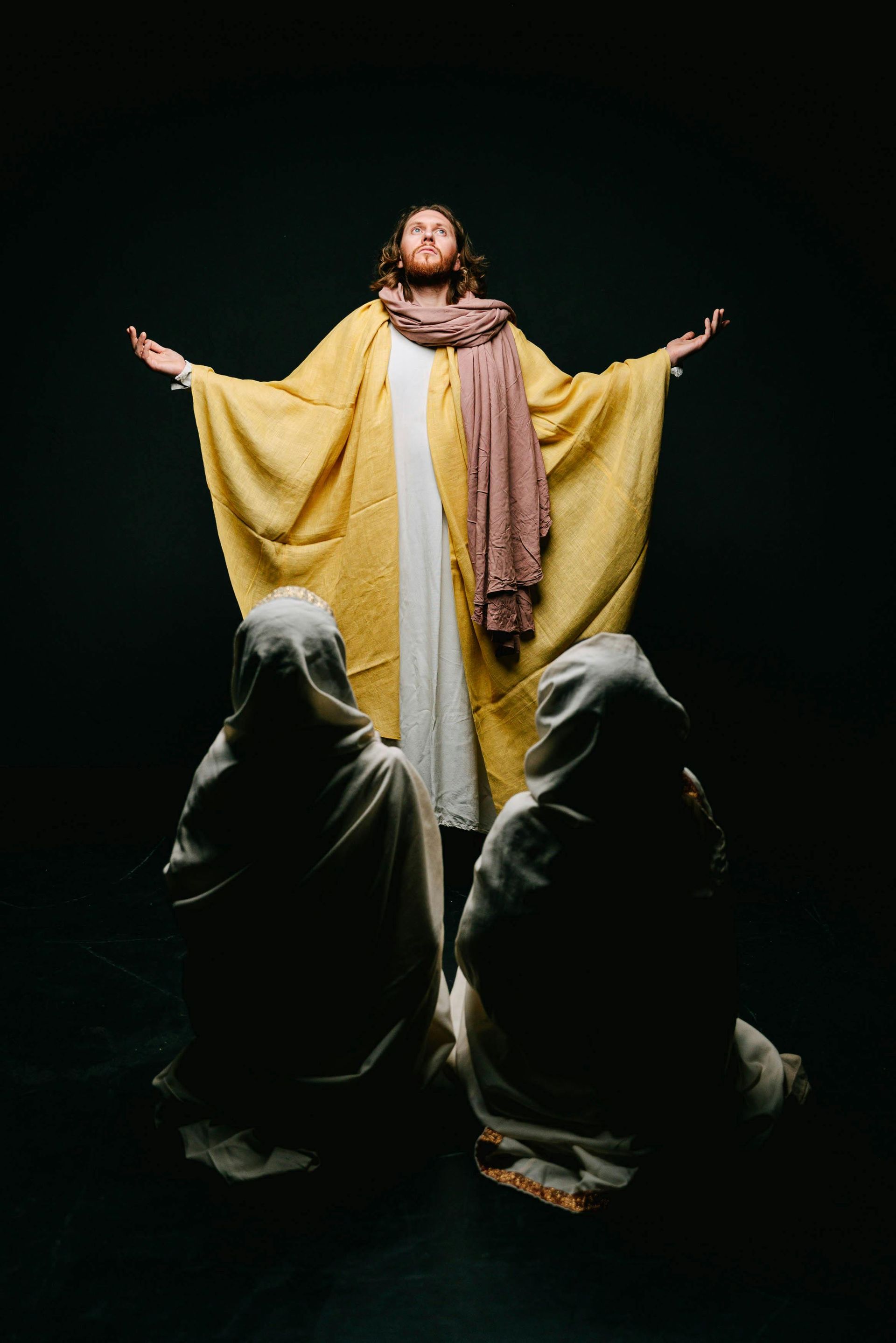
John 20:1-18 But why? Why did Mary stand weeping outside the tomb? There is, of course, the easy answer. Mary stood weeping outside the tomb because, arriving at the tomb, she discovered that Jesus’ body had been stolen. But that’s the easy answer. Easy answers are, as often as not, simplifications; and simplifications are, as often as not, distortions. So, let us look beyond the easy answer and ask again, Why did Mary stand weeping outside the tomb? Mary was one of those people whom nature had favored. And nature does play favorites -- that much is undeniable. Mary was tenacious, discerning, steadfast, spontaneous, courageous – not to mention brimming with natural affections. Yes, she was one of those people whom nature had favored, but sometimes that is not enough. Mary had a bad start in life, and that tends to temper even nature’s most generous gifts. When Jesus first encountered Mary, she was not of sound spirit. She was afflicted and tormented. But Jesus performed a miracle that recalled her to life. She became his passionate and devoted follower. It would seem that her past was behind her. Like with so many others Jesus encountered, Mary had been lost and now was found. But this only led her to the foot of his cross. She had endured the entire spectacle. Dark men – petty, jealous, and scheming -- closed in on him. They subjected him to a farce of a trial, and this only as a formality. They intended to see him executed from the very beginning. The disciples, for their part, panicked and scattered. What if they were next to be targeted? But not Mary. She abided with him those endless hours as he hung on the cross right through to his death agony. She watched from a distance as Joseph of Arimathea and Nicodemus deposed his body from the cross and laid it in a tomb. Mary was shattered. She was traumatized. She was devastated. She was forced to endure the unthinkable – the death of one deeply beloved, and to malicious violence. But Mary was not entirely bereft. She still had his body. She could cleanse and anoint it, bestow upon it what loving care she could. And going forward she could become that person – the one who visits the graveside, the one who keeps memories alive, the one whose tears are never exhausted. In time she would achieve a sort of notoriety for it, but it’s the kind of notoriety no one wants. But she arrived at his tomb only to discover that his body had been stolen. So why did Mary stand weeping outside the tomb? She stood weeping outside the tomb because she had hit rock bottom. I have never hit rock bottom. If dread keeps it at bay, dread has done that much for me. But I have seen others who have. It’s a terrible thing to witness, much less to experience. A kind of derangement takes hold. They aren’t recognizable. They aren’t themselves. This is why Mary couldn’t add up two and two. She peered into the tomb and saw two angels robed in white raiment. Why are you weeping? They asked. Now they didn’t ask because they wanted to hear her theory about the graverobbers. This was not the sense of their question. Woman, why are you weeping? They were asking to convey that there was nothing to weep about. And it was the same thing when the resurrected Jesus asked the same question. Woman, why are you weeping? There’s nothing to weep about. I am alive. I am here. I am with you. Dry your tears. But Mary had hit rock bottom, so it didn’t add up. But then Jesus said something. Something cataclysmic. Something earth shattering. Something beyond description and explanation. And something right under our noses. If there’s one trait we all share, one thing we are all good at, one thing we are all GREAT at, it’s not seeing what’s right under our noses. Jesus called her by name. Mary! he said. And suddenly the truth broke in on her. Dimly, but at the same time, and paradoxically, with crystal clarity. She knew. She knew how we know most deeply – in our bones, in our guts, in our hearts. This man so beloved by her – her teacher, healer, leader, friend….he was much more than that. He was the one that time could not bind, the one that darkness could not thwart. He was the one over whom death had no dominion. He was the one she declared him to be. He was the Lord. And he called her by name . Rock bottom? There was no rock bottom. There was only hope, consolation, meaning, purpose, direction, relief, and rejoicing. From his height to her depth, he called her by name. Rock bottom? She now had good news to proclaim, and she proclaimed it for all she was worth. Friends in Christ, her good news is our good news. No matter what you’ve done, what you are doing, or what you will do. No matter how low you fall. No matter how deep you sink. No matter how bad you’re stuck. His deliverance has your name on it. His triumph has your name on it. His love has your name on it. So let us call him by name – Jesus Christ, our Lord. Amen.

I Samuel 16:4-5 Matthew 5:9 To set the scene for our Old Testament lesson -- Tension was rife. Anxiety was rife. Dread was rife. And why? It was because there was conflict, and conflict produces tension. Conflict produces anxiety. Conflict produces dread. And let’s not pretend that it doesn’t. The hold outs among us might stick their chests out and assert that conflict has no effect on them -- that they are immune from conflict. But personally, I’m a bit skeptical. As I’ve mentioned before, in my various vocations and avocations, I have been subjected to psychological tests. And not just a few of them. And one of the areas that is tested is how you react to conflict – whether you are conflict tolerant or conflict intolerant. According to the tests, I am conflict tolerant, as conflict tolerant as one can be. According to the tests, there is nothing that makes me more comfortable, and more relaxed, and more at ease than conflict. Conflict? Bring it on. There’s nothing I relish more. At least according to the tests. But why is it that in the face of conflict, I become preoccupied. I can’t get it off my mind. I become sleepless. I toss and turn at night. And I feel an enormous sense of relief when the conflict is resolved. So, in my own experience at least, conflict produces tension. Conflict produces anxiety. Conflict produces dread. And that leads us back to our Old Testament Lesson. Talk about conflict! But to understand it, we must back up a bit. In fact, we must back up quite a bit. We all know that Moses received the Ten Commandments atop Mt. Sinai. We all know that with the Ten Commandments in hand, Moses wandered with the people in the wilderness for forty years toward the Promised Land. But we might not all know what happened next. What happened next is that Moses died. Moses was succeeded by Joshua, who conquered the Promised land. And after that? The people settled onto the Promised Land. Since the people were comprised of twelve tribes they settled into the Promised Land accordingly. Each tribe deployed itself on a parcel of land. And they all lived happily ever after. Or not. Problems emerged in short order. The tribes did not get along. Surprise, surprise, the strong tribes picked on the weak ones. Why is it that at all times, and in all places, the strong pick on the weak? But that’s another question. Bottom line, there was disunity among the tribes. Beyond that, they were twelve tribes who each deployed itself on a parcel of land. But they were surrounded by enemies, enemies that had not been wandering around in the wilderness for the past 40 years. Enemies who were trained to fight. So, the people were threatened from within and from without. The closest thing that they had to a leader was Samuel, so they demanded of Samuel a king, a king to unify them and protect them from their enemies. Samuel listened to their demand and anointed King Saul. King Saul was the man of the hour. He was a standout. He stood head and shoulders above all others, was strikingly handsome, and teamed with charisma. He was clearly meant to be. So once again, they all lived happily ever after. Or not. There was something wrong with Saul. Now sometimes when there is something wrong with someone it’s obvious, it’s easy to name – as in the case with addiction, or physically abuse, or mental illness. But sometimes it’s not obvious. Ask twelve scholars what was wrong with Saul, you’ll get twelve different answers. For whatever reason, he proved not to be the stuff of it. He had some fatal flaw. Was it his temper? Was it his jealousy? Was it his paranoia? Was it his anger? Was it his desperation? Because all those things can prove to be fatal flaws. In that last analysis, it doesn’t matter what was wrong with King Saul – simply that there was something wrong with him. Predictably, those closest to him saw it first. But no one else was inclined to believe them. They believed what they wanted to believe, what was easiest to believe. And this is how it goes. The ones closest see it first, and no one is inclined to believe them. Moveover, they didn’t want to face the fact that King Saul was one big false start. But King Saul had some fatal flaw. And fatal flaws are fatal. King Saul deteriorated. It became increasingly difficult to deny. Conflict was brewing. It was not yet open conflict. Soon it would be and in terms too horrific to describe. But rumors were circulating. The atmosphere became charged, and not in a good way. Not one knew just how the thing would play out, but everyone sensed that it would not end well. And that brings us to our Old Testament Lesson. Samuel arrived in Bethlehem, unannounced, unexpected -- in full vestment and with full retinue. What did he want? Why did he single them out? What had they done wrong? Was he there to exact vengeance? In a spark would they all be dead? To set the scene for our Old Testament lesson -- Tension was rife. Anxiety was rife. Dread was rife. And why? It is because there was conflict, and conflict produces tension. Conflict produces anxiety. Conflict produces dread. And so, the people approached Samuel with a question. It was the right question. It was the key question. It was the decisive question. It was this question: Do you come in peace? If you remember one thing about this passage, if you remember one thing about the whole book of Samuel, remember this question. Do you come in peace? Because the people’s question to Samuel is the people’s question to us. Do we come in peace? In the face of conflict do we come in peace? Do we come in peace, or do we come bearing blame for things for which we know we are full well complicit? Do we come in peace, or do we come exacting retribution demanding an eye for an eye? Do we come in peace, or do we come rehearsing old grievances, resentments, jealousies, and grudges? Do we come in peace, or do we come pressing our advantage -- power up, poised to defeat? Because the people’s question to us is also Christ’s question to us? Do we come in peace? Have we gone that extra mile for the one who has burdened us? Have we turned the other cheek? Have we declined to let the sun set on our anger? Have we made peace with our accusers? Do we come in peace? For Christ declares that the peacemakers would be blest, and that through them, but only through them, would his kingdom grow. Amen.
